Boardgame Empire | Where board gaming, astronomy, science, science fiction and fantasy meet.
by Mike Clarke
With files from NASA and the NOAA
It’s official. Last year was the warmest on Earth since record keeping began 135 years ago in 1880.
The announcement Friday, Jan 16, follows two separate analyses by NASA and the National Oceanic and Atmospheric Administration (NOAA ).
It’s the third time in a decade, the Earth has set a new global temperature record.
Map showing global temperatures in 1880 (left) and 2014 (right). (NASA’s Goddard Institute for Space Studies)
Earth broke NOAA records set in 2010 and 2005. The last time the Earth set an annual NOAA cold record was in 1911.
“The 10 warmest years in the instrumental record, with the exception of 1998, have now occurred since 2000,” said NASA in its release. “This trend continues a long-term warming of the planet.”
It’s not often you come across a game that’s such a joy to play — that takes you back to the days where you and your friends faced off across a board with a game you all knew well for a wild contest of one-upmanship with no quarter asked and none given.
Xia: Legends of a Drift System is a go-anywhere, do-anything, sandbox-style adventure that brings back those heady days of oh-so-playable games where you didn’t think about rules. You just played the game.
That’s Xia. It’s easy to learn. Its game play is intuitive. After a few sessions, you don’t need to keep looking things up.
In Xia , you’re the lowly captain of a bargain basement space scow with “brown nylon interior, low-muck, brown flooring and Humkar leather crew seats.”
Unless, of course, instead of the Swamp Rat, you pulled the Numerator, a former lifeboat for the Queen Mary XVIII with the nice white vinyl interior and metal grating on the floors.
The Swamp Rat (left) and the Numerator. One’s a fancy lifeboat, the other – not so much. Both are small and vulnerable.
Ignoring the faint smell of urine and cheap wine, you take the controls and power up the FTL drives. You grin as you prepare to leave behind your old life as an accountant in one of Kemplar II’s minor principalities for a new life of danger and adventure in the largely unexplored and unpredictable post apocalyptic drift system known as Xia — the only drift system in the galaxy stable enough to support the civilizations that nearly blew it to hell more than 400 years ago.
Now I made up that narrative. But it was inspired by the back of a couple of the ship cards and some of the history contained in the rule book. Not bad for a game that one reviewer described as dry as toast and wondered whether it needed an event deck to spice it up.
Comet Lovejoy from the International Space Station (NASA)
Comet Lovejoy will be visible to the naked eye for the first couple of weeks in January near Orion’s belt. For the rest of the month, you can watch it with binoculars. The long period sun-grazing comet will not pass this way again for another 8,000 years.
Still barely visible to the naked eye as a smudge among the stars, Lovejoy has been steadily gaining visibility over the last month. On Dec. 16, it survived a close encounter with the Sun many astronomers thought would rip apart its icy core.
Watch Comet Lovejoy encounter the Sun
NASA Youtube video loops 3 x
An armada of unmanned spacecraft documented something many astronomers thought impossible. Lovejoy flew through the hot atmosphere of the Sun, only 120,000 km above its surface and emerged intact — its distance from the Sun far closer than the Moon is to the Earth.
“I did not think the comet’s icy core was big enough to survive plunging through the several million degree solar corona for close to an hour,” said Karl Battams with the Naval Research Lab in Washington DC.
At least five spacecraft recorded the comet’s close encounter: NASA’s Solar Dynamics Observatory and twin STEREO probes, Europe’s Proba2 microsatellite, and the ESA/NASA Solar and Heliospheric Observatory.
Lovejoy was discovered on Dec. 2, 2011, by amateur astronomer Terry Lovejoy of Australia. Researchers quickly realized that the new find was a member of the Kreutz family of sun-grazing comets.
Named after the German astronomer Heinrich Kreutz, who first studied them, Kreutz sungrazers are fragments of a single giant comet that broke apart back in the 12th century.
Reprinted with permission from author Andy Weir, this short story was named one of the four best Stumbles of 2014 by StumbleUpon. Read more from Andy at http://www.galactanet.com.
You were on your way home when you died.
It was a car accident. Nothing particularly remarkable, but fatal nonetheless. You left behind a wife and two children. It was a painless death. The paramedics tried to save you, but to no avail. Your body was so utterly shattered, you were better off. Trust me.
And that’s when you met me.
“What…what happened?” you asked. Where am I?
“You died,” I said matter-of-factly. No point in mincing words.
“There was a truck..and it was skidding…”
“Yup,” I said.
“I…I died?”
“Yup. But don’t feel bad about it. Everybody dies, “I said.
You looked around. There was nothingness. Just you and me. “What is this place?” you asked. “Is this the afterlife?”


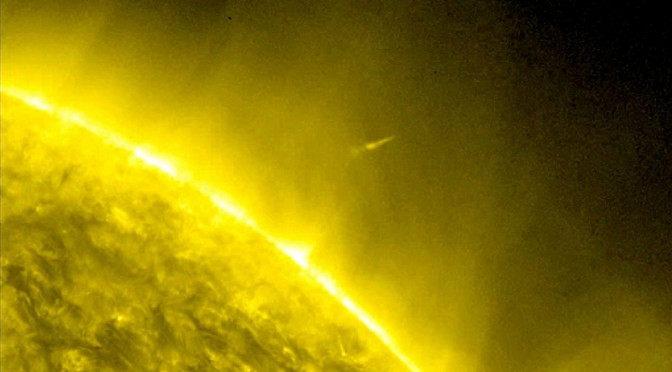


 printed with permission from author Andy Weir, this short story was named one of the four best Stumbles of 2014 by StumbleUpon. Read more from Andy at
  “Yup. But don’t feel bad about it. Everybody dies, “I said.