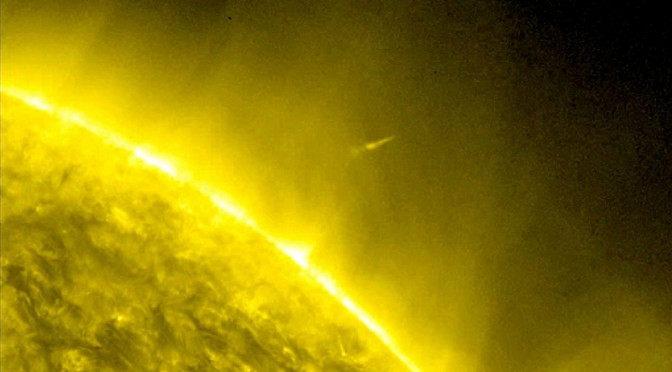
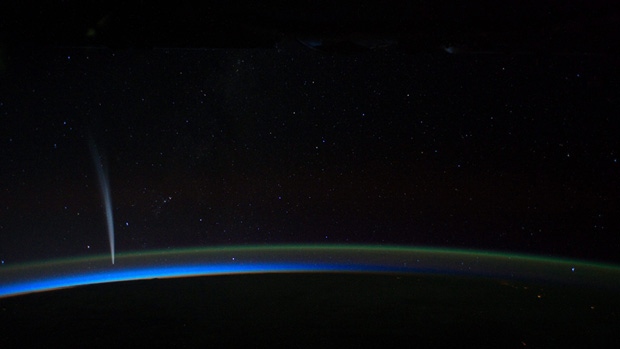
Comet Lovejoy will be visible to the naked eye for the first couple of weeks in January near Orion’s belt. For the rest of the month, you can watch it with binoculars. The long period sun-grazing comet will not pass this way again for another 8,000 years.
Still barely visible to the naked eye as a smudge among the stars, Lovejoy has been steadily gaining visibility over the last month. On Dec. 16, it survived a close encounter with the Sun many astronomers thought would rip apart its icy core.
Watch Comet Lovejoy encounter the Sun
NASA Youtube video loops 3 x
An armada of unmanned spacecraft documented something many astronomers thought impossible. Lovejoy flew through the hot atmosphere of the Sun, only 120,000 km above its surface and emerged intact — its distance from the Sun far closer than the Moon is to the Earth.
“I did not think the comet’s icy core was big enough to survive plunging through the several million degree solar corona for close to an hour,” said Karl Battams with the Naval Research Lab in Washington DC.
At least five spacecraft recorded the comet’s close encounter: NASA’s Solar Dynamics Observatory and twin STEREO probes, Europe’s Proba2 microsatellite, and the ESA/NASA Solar and Heliospheric Observatory.
Lovejoy was discovered on Dec. 2, 2011, by amateur astronomer Terry Lovejoy of Australia. Researchers quickly realized that the new find was a member of the Kreutz family of sun-grazing comets.
Named after the German astronomer Heinrich Kreutz, who first studied them, Kreutz sungrazers are fragments of a single giant comet that broke apart back in the 12th century.
With files from NASA and space.com