It’s not often you come across a game that’s such a joy to play — that takes you back to the days where you and your friends faced off across a board with a game you all knew well for a wild contest of one-upmanship with no quarter asked and none given.
Xia: Legends of a Drift System is a go-anywhere, do-anything, sandbox-style adventure that brings back those heady days of oh-so-playable games where you didn’t think about rules. You just played the game.
That’s Xia. It’s easy to learn. Its game play is intuitive. After a few sessions, you don’t need to keep looking things up.
In Xia , you’re the lowly captain of a bargain basement space scow with “brown nylon interior, low-muck, brown flooring and Humkar leather crew seats.”
Unless, of course, instead of the Swamp Rat, you pulled the Numerator, a former lifeboat for the Queen Mary XVIII with the nice white vinyl interior and metal grating on the floors.
The Swamp Rat (left) and the Numerator. One’s a fancy lifeboat, the other – not so much. Both are small and vulnerable.
Ignoring the faint smell of urine and cheap wine, you take the controls and power up the FTL drives. You grin as you prepare to leave behind your old life as an accountant in one of Kemplar II’s minor principalities for a new life of danger and adventure in the largely unexplored and unpredictable post apocalyptic drift system known as Xia — the only drift system in the galaxy stable enough to support the civilizations that nearly blew it to hell more than 400 years ago.
Now I made up that narrative. But it was inspired by the back of a couple of the ship cards and some of the history contained in the rule book. Not bad for a game that one reviewer described as dry as toast and wondered whether it needed an event deck to spice it up.
This game has back story coming at you in spades. From the ships, each with their own personal captain’s stories and design details that include make, model, engines and avionics, to the three full pages the rulebook devotes to the 21 hex tiles that outline Xia’s rich and bloody past.
The second time we played the game (the first has to be devoted to learning it) we’d occasionally look in the rulebook and read about the tile we were flipping — not every one, because you don’t want it to be work. By the time the third play rolled around, the system’s rich story had been laid out and our imaginations were humming.
As we uncovered new areas, the story changed and grew.
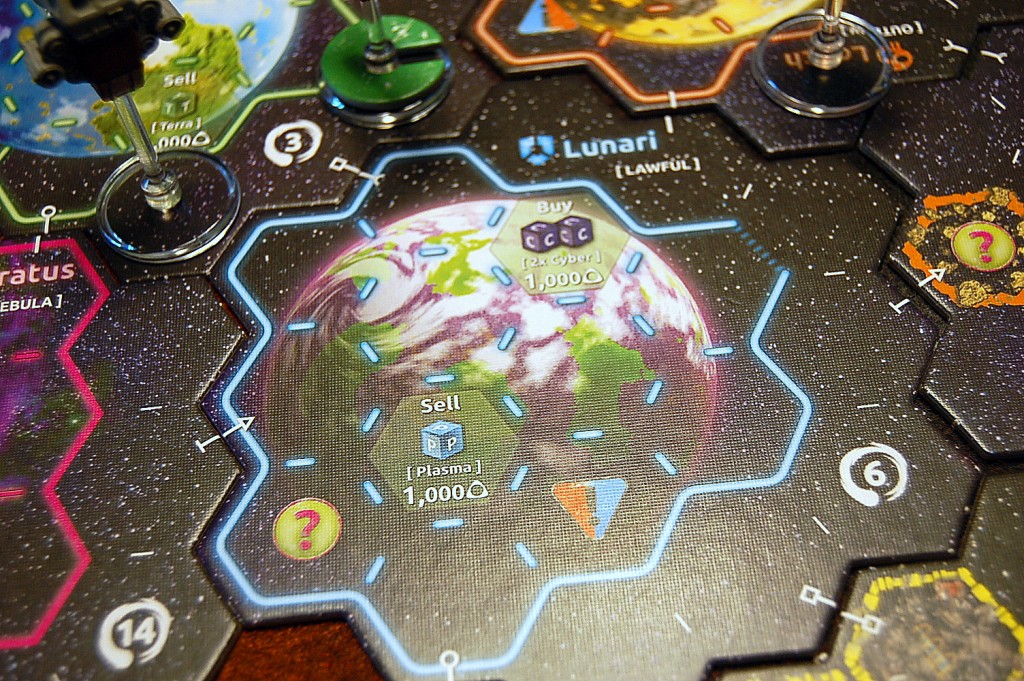
The chemical complexity of the flora and fauna of the vast purple tundras and emerald oceans of Lunari once attracted the philosophers and free thinkers whose planetary studies gave it its start as an education centre.
Lunari: Beautiful and dangerous.
Then, growing militarization led to corporations financing questionable research other planets forbid. Now, whether you’re the specimen or the scientist, these are dangerous days on Lunari.
Again, my narrative condensed from the rulebook’s history of Lunari.
You gotta love a game that let’s you do that.
And that gives you something to think about when you’re selling that pretty purple-white planet the plasma it needs to support the cybernetics research it’s doing. It also helps you remember without having to look at the board, what resources it buys: plasma and sells: cybernetics.
Xia is rich in history, but you’re also building a story playing it. A lot of games get their story from flavour text on cards. Xia’s cards give you just enough detail to get your mind rolling, but the real story isn’t in the cards. It’s in the perils you undertake fulfilling them. Those damn hexes are full of them: nebulae to suck out your energy, debris fields with hidden nukes for instant death (1-3 d20), asteroids to wreck your ship while the game’s NPCs take pot shots at you.
Xia is a race game
And you will be taking those calculated risks and putting yourself in danger because at its core, Xia is a race game — a race game with blasters…and missiles!
And that brings me back to the fun, exciting, squared-off-across-the- board, no quarter given, none taken, free-for-all game play I mentioned in the opening.
It’s a table hog but with 19 spaces on each of 21 hexes, that’s 400 spaces in which to maneuver.
There are nine paths to fame: exploration, ship upgrades, missions, trade, wealth, kindness, combat, titles and luck. Usually you’re mixing up all of them so you can grab one of them on your turn, or set yourself up for the next one because…like I said, it’s a race.
You’re playing to a pre-set number of fame points: five for a short game, ten for a regular game, 15 which is my game and 20 for the Tier 3 ships and the full Xia experience.
You can play for as long or short as you want, play to fame points or to a time deadline, say two hours — most fame wins.
Making the most of your time is what this game is all about. This is not a leisurely stroll through the galaxy. It’s a mad dash to the finish line. You want and need to push your luck, but take ridiculous chances and you’ll easily fall behind.
A lot has been said about Xia’s randomness. I haven’t found that. Yes you have to roll dice, but you’re rolling so much dice that over the course of the game, it really does even out. More importantly, you get to improve dice rolls with ship skills, ship upgrades, completed Missions (they provide re-rolls) and Titles.
The Merchant ship, an NPC, is now a sitting duck with $6,000 credits and four damage points on her. $5,000 credits buys you a fame point and a ship upgrade.
Improving your ship gives you significantly greater odds at succeeding at everything. It’s not randomness that kills you in this game. It’s bad planning.
There’s so much to do, so many ways to go and other players to consider that you can easily make a costly time error.
I mentioned playability that comes from an intuitive rule set. One thing I really like about this game is how easy it is to remember the rules. For instance there’s a bunch of different borders you cross in this game. But remembering the die rolls for all of them is dead simple. On a 1-10 you take that much damage or energy loss (mitigated of course by your shields). On a 11-20 you succeed.
Yes you can get different effects for failure, but rather than a different chart for each type of border, the rules were deliberately simplified to enhance play.
Xia is component heaven
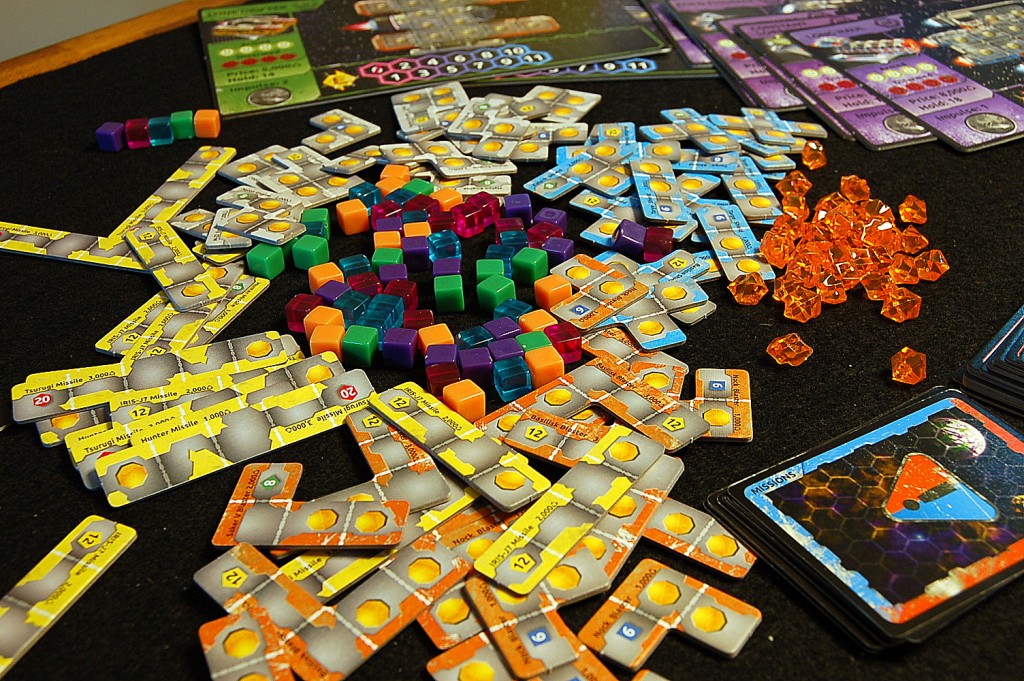
Xia is a work of art. The tiles are gorgeous and thick. The colourful ship mats are beautifully rendered, currency is heavy metal coins. You get translucent cubes, crystal damage markers and 21 pre-painted ship minis.
Translucent cubes and crystal damage markers are a nice touch. Note the puzzle piece structure of the “outfits” you use as engine, shields, missiles and blasters.
This is clearly a labour of love by Cody Miller, a designer who wanted us to experience the game exactly as he imagined it, and spent money he could have pocketed for profit, to give us that kind of over-the-top production.
Yes I know it’s not cheap, but given what you get, it’s a bargain.
The game isn’t perfect. Random card and tile draws and bad dice rolls can sometimes conspire against you in a game. But games like that are rare. They’re the exception, not the rule.
Sometimes buy and sell points line up at adjacent planets limiting game-play by providing quick and easy points for one particular strategy.
But there’s an easy fix for that.
Don’t allow players to sell at the same place twice in a row and use the extra marker provided in the game to remember the no-trade planet until you’ve sold somewhere else then move the marker there.
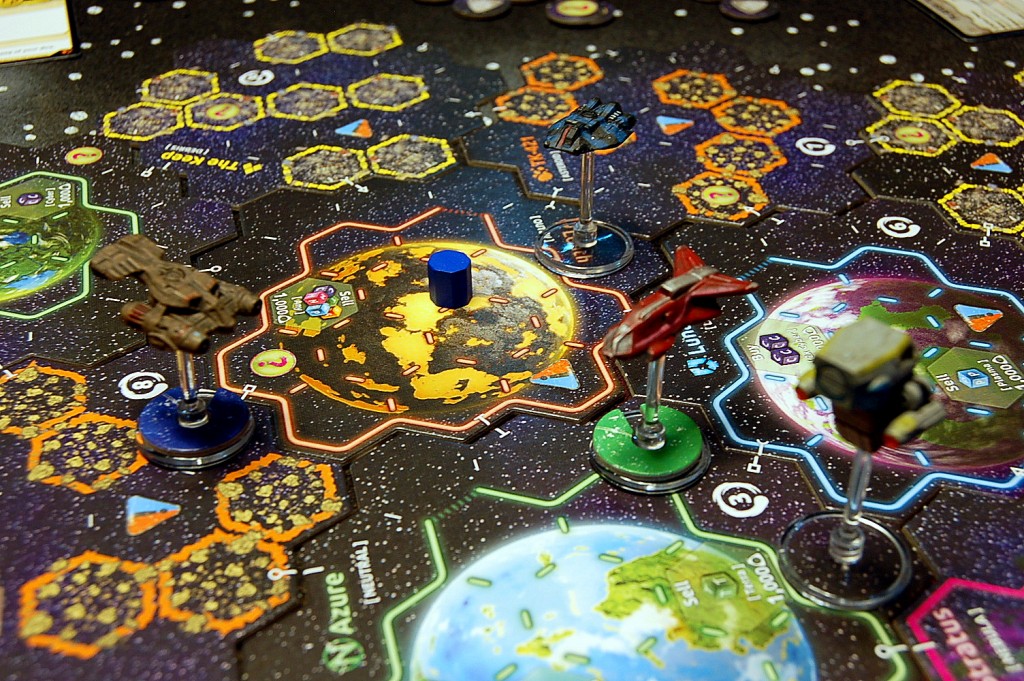
The blue player can’t sell at the outlaw planet, Loath because his marker is there meaning he’s shut out until he sells somewhere elsE first. That’s too bad because Loath accepts EVERYTHING.
I’ve seen other solutions that involve multiple cube exchanges and mats to keep track of things, but to me they’re way too complicated for what is such an easy fix
It’s the only real flaw I found in the entire game and it’s really pretty minor. Some don’t consider it a flaw at all, because with enough armed players, you can punish the route exploiter.
However, I like my solution better because it works in every instance, is dead simple, doesn’t change Cody’s game by switching planetary cargo (there goes Lunari’s back story) and doesn’t rely on combat.
Xia is about story
Doravin V is a tree-hugger’s back-to-nature paradise, with fertile homesteads attracting those wanting a simpler life. It needs “cybernetics” ie: technology, but has lots of “terra” to sell — terra being anything produced by rocky planets: crops, minerals etc…
Kemplar II is the seat of power of a post-war decaying and corrupt government, whose opulent palaces and marble streets are now slowly fading into ruin . It can sell you spice and wants…well…”holo” products because the masses need their entertainment.
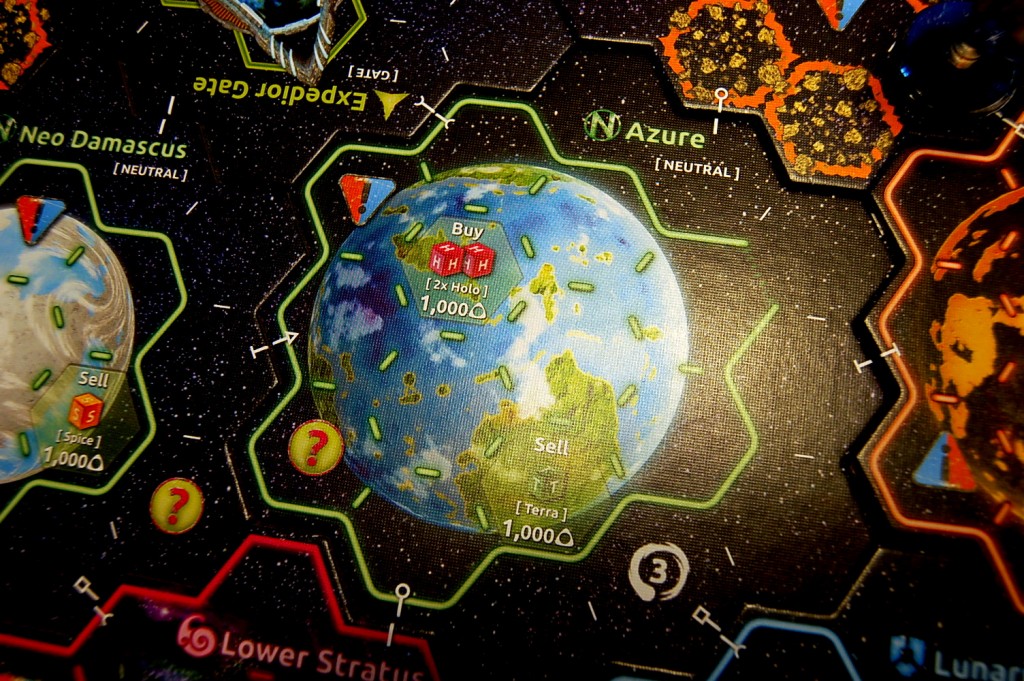
You can get “holo” at Azure, the pleasure and tourist centre of Xia’s little drift system in exchange of course for the raw materials or “terra” Azure needs to make it.
Time for a little trading. Azure is a pleasure planet that sells Holo products but needs Terra to make them.
There’s a beautiful symbiosis to Xia’s trade routes, but you can ignore all that. That’s a lot of text to read, right? Then you’re just playing a game where you’re moving minis around a map and pushing different coloured cubes. Now you can blame the designer for creating a game as dry as dust.
Thematic board games live in the imagination. They put you in the adventure. They’re like a good book, but instead of reading about it you’re living it. If you don’t engage the imagination, it’s just cardboard and you’d be better off playing a good abstract.
So I guess to paraphrase another reviewer, Xia is a game for the right type of gamer. That’s a gamer who doesn’t need to showcase his superior skills by putting a beat-down on his opponents — a gamer with imagination, who can still dream and wants to have fun with the experience — win or lose.
And Xia’s constant decisions and race mechanic make it a fun game to play.
Not only is there’s always something interesting to do on your turn, you also get to upgrade your ship to a larger one, not once but twice during the game, acquiring new game-changing skills each time as you graduate to eye-pleasingly, bigger and better minis, representing vessels with new skill sets.
In a full game you’ll get to play with three different ships and their miniatures —the one you started in and the two to which you upgraded.
There’s also fun to be had in the outfits (engines, shields, blasters and missiles) you buy to arm, defend and move your ships. Outfits come in three progressively larger dice sizes and are real puzzle pieces that fit better in some ship configurations than in others.
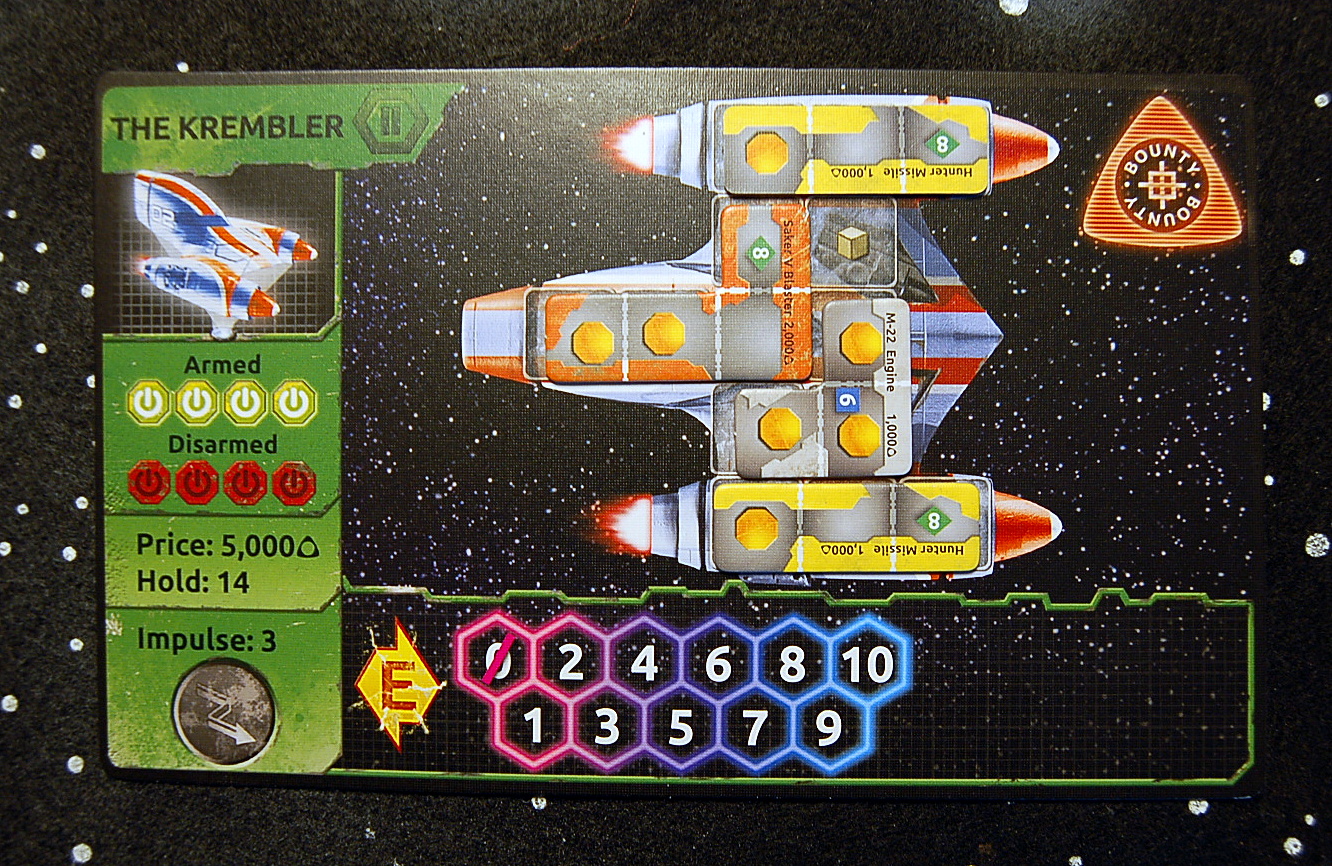
For instance, the Krembler is only a Tier II ship, but its shape allows it to hold two d8 missiles, a d8x2 baster, and a d6x3 engine making it in that particular configuration slow but powerful for its level. Every ship in Xia is shaped differently and the Krembler’s shape provides two, three-space pods, one on each side, that fit the d8 missiles perfectly. But you can also put other stuff in there instead.
The Krembler outfitted with missiles (yellow), blasters (orange) and engines (grey) Note, the two pods on its starboard and port sides perfect for d8 missiles.
If you outfit it that way without shields it’s a bit of a sitting duck, but you can replace one of the missiles with a shield at the next planet —only because the Krembler’s configuration supports that particular swap. Others won’t, but will be shaped to offer other opportunities like space for the powerful d12x3 shields and a d12x3 engine.
The Krembler plying the drift system near Xia itself.
I installed one of those engines last game. It felt like I was in a Ferrari.
And there’s room for a ship like that. With 19 spaces on each of 21 hex tiles, when they’re all in play you’ve got nearly 400 spaces to explore.
So you’ve configured the Krembler for firepower. And if no-one else has yet armed themselves, maybe you can get away without those shields. It depends on your plan. Once you’ve performed your attack, you can hit the next planet and re-arrange your armament, dropping missiles for shields so you can defend yourself against the player you just attacked or against asteroids ’cause now you’ve decided you want to do a little resource exploitation for cash.
You’re always limited by your ship’s configuration. No one ship can do it all, but most ships are pretty flexible.
Whatever you decide to do, Xia is a race to the finish, where you’re starting out in small ships zipping around the board, flipping tiles for exploration points, completing Missions only to end the game in powerful cruisers, often armed to the teeth, grabbing Titles, taking out NPCs and slowing down players that get in your way.
Xia: spectacular to look at. Fun to play.
It’s a fun-filled romp on a beautiful map, with eye-catching components, gorgeous ship miniatures and a rich back story to fire your imagination.
I think this game is just going to get better. Cody designed the system to be easily modded and expandable, Already Kip Kwiatkowski (kgk4569) and Paul Wilson (Smuge) have created the first full fan-made expansion for Xia with full-colour tiles, new NPCs, a Space Station and a new story (Invasion) that dovetails with the existing one.
I think we’re always looking for that perfect board game even though most of us know there’s no such thing.




Had a great time reading this and having played it, I think you nailed it!